
Extreme Golf
HAEGIN Co., Ltd.Sports
4.53.52K Reviews
- Version
- 2.1.11
- Installs
- 1.00M
- Age Rating
- Teen
Screenshots


Our Review of Extreme Golf
 Analysis by Appyee
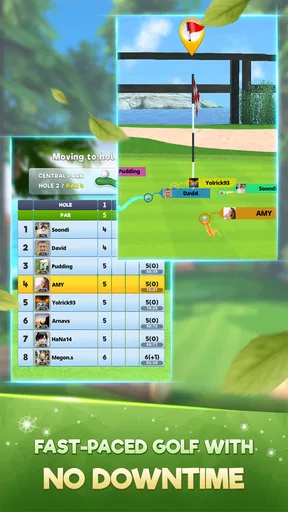
I expected Extreme Golf to be a quick sports game built around simple swings, but my first sessions showed a more focused idea: golf designed to keep every player involved at the same time. Instead of waiting through a long sequence of turns, I play alongside other golfers in real time, making decisions under pressure while the course keeps moving. That change gives the game a noticeably livelier mood than a traditional golf simulator.
HAEGIN Co., Ltd. presents it as a free sports game for mobile devices, and it is available to players using Android 6.0 or later. The game has reached over a million installs and holds a 4.5 average from around 40 thousand ratings, which fits my impression that it is easy to understand but has enough competitive tension to encourage repeated matches. Its content rating is Teen, so it is aimed at an older audience than a purely child-focused casual game.
What stayed with me most was the relationship between presentation and play. The colorful course design makes each match feel approachable, while the simultaneous format adds urgency without turning the experience into a complicated simulation. I would recommend it to someone who wants short competitive golf sessions, especially when a full console-style round feels too slow. I would be more cautious about recommending it to players who want quiet, realistic golf with plenty of time to study every shot.
Bright courses, readable action, and a quick first impression
The opening experience is built around getting me into a match quickly. That matters because the main appeal is not learning a large collection of menus or studying a detailed career structure; it is understanding the shot, reacting to the course, and seeing how my result compares with other players in the same contest. The interface keeps the focus on the next action, which makes the game approachable even when I only have a few minutes available.
The visual direction supports that accessibility. Courses and characters use a lively, polished style rather than aiming for photographic realism. I can read the important elements without feeling that the screen is crowded with technical information. The result is a world that feels more like a competitive animated sports show than a serious golf broadcast. That choice is useful on a phone because the game communicates its mood at a glance.
My first useful discovery was that speed does not mean I can play carelessly. The real-time structure removes the downtime between turns, but it does not remove the need to judge a shot. I still have to balance a safe decision against a more ambitious one, and the pressure comes from knowing that other players are progressing while I am lining up. The game therefore creates an immediate contrast: its appearance is friendly, but its matches can become surprisingly tense.
That contrast also explains why the game works better as a repeatable short-session title than as a relaxing golf toy. A single match can fit naturally into a break, a commute, or the few minutes before an appointment. However, the competitive format asks for attention. If I am distracted, the bright presentation does not make missed timing feel harmless; it simply makes the mistake easy to notice.
The free entry point is another practical advantage. I can try the core experience without paying first, then decide whether the competitive loop suits me. The game includes in-app purchases ranging from $0.99 to $99.99 per item, so I would approach spending carefully and treat purchases as optional rather than part of the basic reason to install it. Anyone who dislikes games that place paid items around a competitive progression should inspect the purchase flow before committing time or money.
The course design speaks through color and shape
The setting does not try to build a large narrative world around golf. Instead, it communicates through visual language: bright environments, distinct obstacles, and a playful sense of scale. That restraint is a strength. I am not asked to remember story details before I can enjoy a match, and the courses feel like stages made for immediate competition.
Because the game is played on a relatively small screen, visual clarity matters more than elaborate scenery. The art direction gives the course a clear identity without burying the playable route beneath decoration. When I am deciding whether to attempt a risky line, I want to understand the terrain quickly. The colorful style helps preserve that readability while keeping the setting cheerful.
There is also a useful emotional effect in the way the world frames failure. A poor shot feels like a setback inside a playful environment rather than a harsh simulation of golfing frustration. That does not eliminate disappointment, especially when a mistake changes the result of a close match, but it keeps the overall mood from becoming heavy. I can lose and still feel ready to try again because the game’s visual personality remains inviting.
Players looking for a realistic golf atmosphere may find this approach too stylized. The courses are not primarily there to reproduce the quiet seriousness of a real club. They are competitive spaces designed to make movement, obstacles, and timing understandable. In my view, that makes the game more suitable for casual multiplayer sessions than for players who enjoy comparing virtual clubs, reading detailed terrain, or recreating a complete outdoor round.
One practical tip is to treat the scenery as information, not just decoration. The strongest players are not merely reacting to the swing control; they are reading the shape of the route and recognizing when a visually tempting option may be less reliable. The art direction works best when I use its clarity to make faster decisions rather than simply admiring the background.
Sound and pacing keep the match from feeling static
The most important rhythm comes from simultaneous play. In a conventional turn-based golf game, the atmosphere can become quiet while another player takes a shot. Here, the match has a more continuous pulse because everyone is acting within the same contest. That makes the game feel active even when I am not currently watching my ball travel.
This pacing changes how I listen to the game as well as how I play it. Sound effects and match feedback have a functional role: they help mark the result of an action and keep the player connected to the unfolding round. The overall presentation feels lighter and more energetic than a realistic golf soundtrack would, which suits the compact format. I do not experience the course as a silent landscape; I experience it as a stage for rapid decisions.
The rhythm is especially effective when a match becomes close. I may begin with a relaxed approach, but the knowledge that other players are advancing makes each delay feel meaningful. A cautious player can still think, yet there is less room for endless adjustment. That balance is one of the game’s clearest identities: it is not an arcade game with no consequences, but it is also not a slow simulator that waits patiently for every calculation.
For everyday use, I would play with the sound at a comfortable level rather than treating it as background noise. The audio and visual cues help maintain awareness of what is happening, particularly when the action around the course becomes busy. At the same time, the game remains understandable as a visual experience when I need to keep my phone quiet. The important point is that the sound design supports the pace instead of trying to create a dramatic story that the game does not need.
That pace can become the main source of friction for beginners. A new player may understand the basic objective but still feel rushed when several decisions arrive close together. My advice is to use early matches to learn the timing and the visual language of the courses rather than chasing perfect results immediately. The game rewards familiarity with its tempo, and that familiarity develops through repetition more than through reading instructions.
Real-time golf makes simple controls more demanding
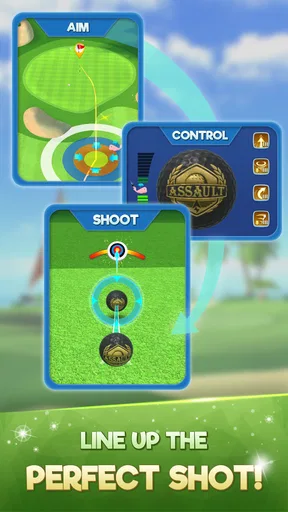
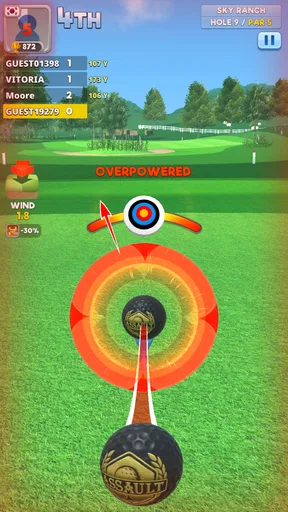
The central mechanical fit is strong because the real-time format gives ordinary golf actions a competitive edge. The controls are easier to approach than a full simulation, but the match context makes them matter. I am not only asking whether a shot is technically possible; I am asking whether it is worth attempting while other players continue to move.
This creates several useful trade-offs. A safer route may protect a lead, while a bold option may be necessary when I am behind. A quick decision can preserve momentum, but rushing can turn a manageable hole into a recovery problem. These choices are what prevent the game from feeling like a simple sequence of taps. The accessible presentation hides a layer of judgment that becomes clearer after several matches.
One of my more practical habits is to separate learning from competing. On an unfamiliar course, I first pay attention to how the route behaves and which visual cues suggest danger. Once I understand the layout, I can use the real-time pressure more intelligently. This is more effective than repeating the same aggressive approach and blaming the controls when the result goes wrong.
The game is also a better fit for players who enjoy improvement through short attempts than for those who want a long uninterrupted campaign. Each match gives me a contained test: read the situation, choose a line, execute, and adapt. That structure makes it easy to return after a break. It also means that players who need a strong narrative reason to continue may find the competitive loop less motivating.
Compared with ordinary single-player golf games, the biggest difference is the absence of long waiting periods. Compared with golf simulators, the advantage is accessibility and speed rather than realism. Compared with other quick competitive mobile games, the appeal comes from the unusual combination of calm-looking courses and pressured decision-making. I would choose this over a traditional golf app when I want interaction and immediacy; I would choose a slower alternative when I want to practice patiently or enjoy a more authentic club atmosphere.
The current version is 2.1.11, and the game has been available since Apr 5, 2020. Those details matter less to my daily enjoyment than the underlying format, but they show that this is an established mobile title rather than a brand-new experiment. I would still check that my device meets the Android requirement before installing, especially if I use an older phone.
Another point worth considering is the social pressure built into real-time competition. Even without turning the game into a serious esport, the format can make a short session feel more demanding than expected. Someone who enjoys comparing performance and responding quickly will probably find that motivating. Someone who prefers playing entirely at their own pace may feel that the game’s strongest feature is also its central limitation.
Who will enjoy it, and who should choose another golf game?
I think Extreme Golf is best for mobile players who want golf matches that begin quickly, stay active, and reward better decisions over repeated sessions. It suits someone who likes a colorful presentation but still wants a contest with consequences. It is also a good choice for a player who often has only a small window for gaming and wants something more involved than a one-touch arcade diversion.
A realistic everyday scenario would be a short break between tasks. I can start a match, focus for a few minutes, and finish with a clear sense of having played something competitive rather than merely passing time. The game’s pacing makes that possible, but I would not launch it while walking, multitasking, or trying to relax with no attention available. Real-time play is most enjoyable when I can give the course my full focus for the duration of the match.
I would skip it if my main goal were a quiet solo golf experience. The simultaneous structure is not a minor extra; it shapes the entire mood and decision cycle. Players who dislike competition, quick reactions, or the possibility of spending on optional items may be happier with a slower offline golf title. Likewise, anyone seeking detailed simulation should look for a game built around realism rather than bright stage-like courses and rapid contests.
For new players, I recommend resisting the urge to treat every hole as a chance for a spectacular result. Learn how the course presents its safe and risky choices, then decide when the aggressive line is actually justified. This approach makes the game less frustrating and reveals its deeper strength: it is about managing pressure, not simply hitting the ball as far as possible.
My verdict on the playable mood
After spending time with it, I see Extreme Golf as a carefully balanced sports game whose personality comes from the meeting of art direction, sound, and pacing. The colorful setting makes the action welcoming, the audio and feedback keep matches moving, and the real-time structure turns familiar golf decisions into moments of pressure. None of those parts needs a large story to work; together, they create a clear mood that is energetic, friendly, and competitive.
Its limitations are equally clear. The fast format may overwhelm players who want to think without a clock-like sense of urgency, and the stylized presentation will not satisfy everyone looking for realistic golf. The presence of in-app purchases also means I would play for the core competition first and keep spending under control. Those are not reasons to dismiss the game, but they are important when deciding whether its design matches your habits.
For me, the strongest recommendation is simple: install it if you want real-time multiplayer golf with a bright, quick-moving atmosphere, and you are comfortable improving through repeated short matches. The game’s 4.5 average and broad install base suggest that many players have connected with that formula, but my own reason to return is more specific. It transforms waiting for a turn into active decision-making without losing the readable charm that makes a mobile sports game easy to pick up.
Extreme Golf is not the right replacement for a serious golf simulator, but it does not need to be. Its goal is to make golf feel immediate, social, and playable in compact sessions. When I want a lively contest that combines approachable visuals with meaningful shot choices, it delivers a coherent experience. When I want silence, realism, or complete control over the pace, I reach for a different kind of game.
Verdict
Strengths of Extreme Golf
- Quick matches are ideal for short gaming sessions.
- Simple controls make it easy for new players to start.
- Online competition adds excitement and replay value.
- Course variety keeps rounds from feeling repetitive.
- Upgrades and rewards give players reasons to return.
Limitations of Extreme Golf
- Some advanced clubs or items may require significant grinding.
- Online matches can feel frustrating against highly skilled players.
- Progress may depend heavily on consistent daily play.
- Ads or optional purchases can interrupt the overall experience.
- A stable internet connection is needed for most multiplayer features.
Other Releases by HAEGIN Co., Ltd.
View All
Homerun Clash
Sports4.4
Similar Picks in This Category
View All
8 Ball Pool
Miniclip.com4.8

Pooking - Billiards City
AIM TOP GAME TECHNOLOGY LIMITED - pool4.6

Carrom Pool: Disc Game
Miniclip.com4.4

EA SPORTS FC Soccer Mobile 26
ELECTRONIC ARTS4.6

World Soccer League
mobirix4.3

Soccer Cup 2026: Football Game
INLOGIC SPORTS - football tennis golf soccer4.3
Frequently Asked Questions
What is Extreme Golf, and how does the gameplay work?
Extreme Golf is a competitive mobile golf game focused on quick, online matches rather than a traditional single-player career. You aim, adjust the power and direction, and try to complete each hole with as few strokes as possible. Matches are designed to be easy to start but increasingly demanding, with wind, terrain, timing, and club selection affecting every shot.
Can I play Extreme Golf offline, or is an internet connection required?
An internet connection is generally required for the main Extreme Golf experience because the game is built around real-time or online competitive modes, player rankings, events, and account progression. You may be able to access certain menus or practice-related features without a stable connection, but offline play is limited. For the smoothest experience, Wi-Fi or a reliable mobile data connection is recommended.
Is Extreme Golf free to download and play?
Extreme Golf can typically be downloaded and played for free, but it may include optional in-app purchases. These purchases can be used for items such as currency, upgrades, cosmetic content, or progression-related benefits. Spending money is not necessarily required to enjoy the game, although players who compete frequently may notice that progression, equipment improvement, or event participation can be influenced by available resources.
Does Extreme Golf support multiplayer matches and competitive events?
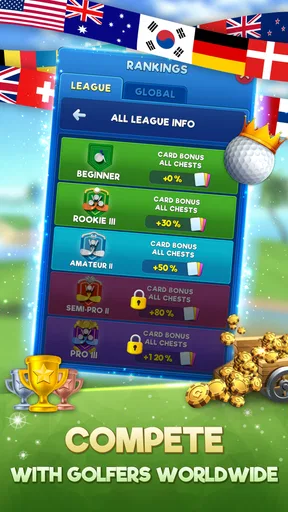
Yes, multiplayer competition is one of Extreme Golf’s main attractions. You can challenge other players through online matches and take part in competitive formats where accuracy, speed, and consistency matter. Depending on the current version and available events, the game may also include tournaments, leagues, rankings, or special challenges. Matchmaking quality can depend on your connection and the number of active players.
What devices are compatible with Extreme Golf, and does it require powerful hardware?
Extreme Golf is designed for Android and iOS smartphones and tablets, but compatibility depends on the operating system version and the specific device. Basic gameplay should work on many modern mid-range phones, while newer devices usually provide faster loading, smoother animations, and more stable performance during online matches. Before downloading, check the app store listing for current system requirements and available storage.
Play our best games!


